Data Pipeline using Lambda, S3 & Athena
The Underrated Stack for Lightweight workload.
Whenever anyone talks about data pipelines, the first thing that pops into our mind is Spark clusters, Airflow DAGs, complex orchestration, and over-provisioned data warehouses. But not every pipeline needs that much muscle.
Sometimes, what you need is fast, light, and easy to maintain.
That’s where the combination of AWS Lambda + S3 + Athena quietly shines.
It’s a minimal yet powerful stack perfect for daily ingestion, log analytics, ad-hoc queries, and lightweight ETL tasks.
The Core Components
Amazon S3: The foundation of a cost-efficient, durable, and infinitely scalable data lake.
AWS Lambda: Event-driven compute that scales with your needs and costs nothing when idle.
Amazon Athena: Serverless SQL engine that lets you query your S3 data with zero setup.
Together, they form a pipeline that is:
Event-driven
Serverless
Highly cost-efficient
Easy to deploy and operate
How It Works: A Simple Data Flow
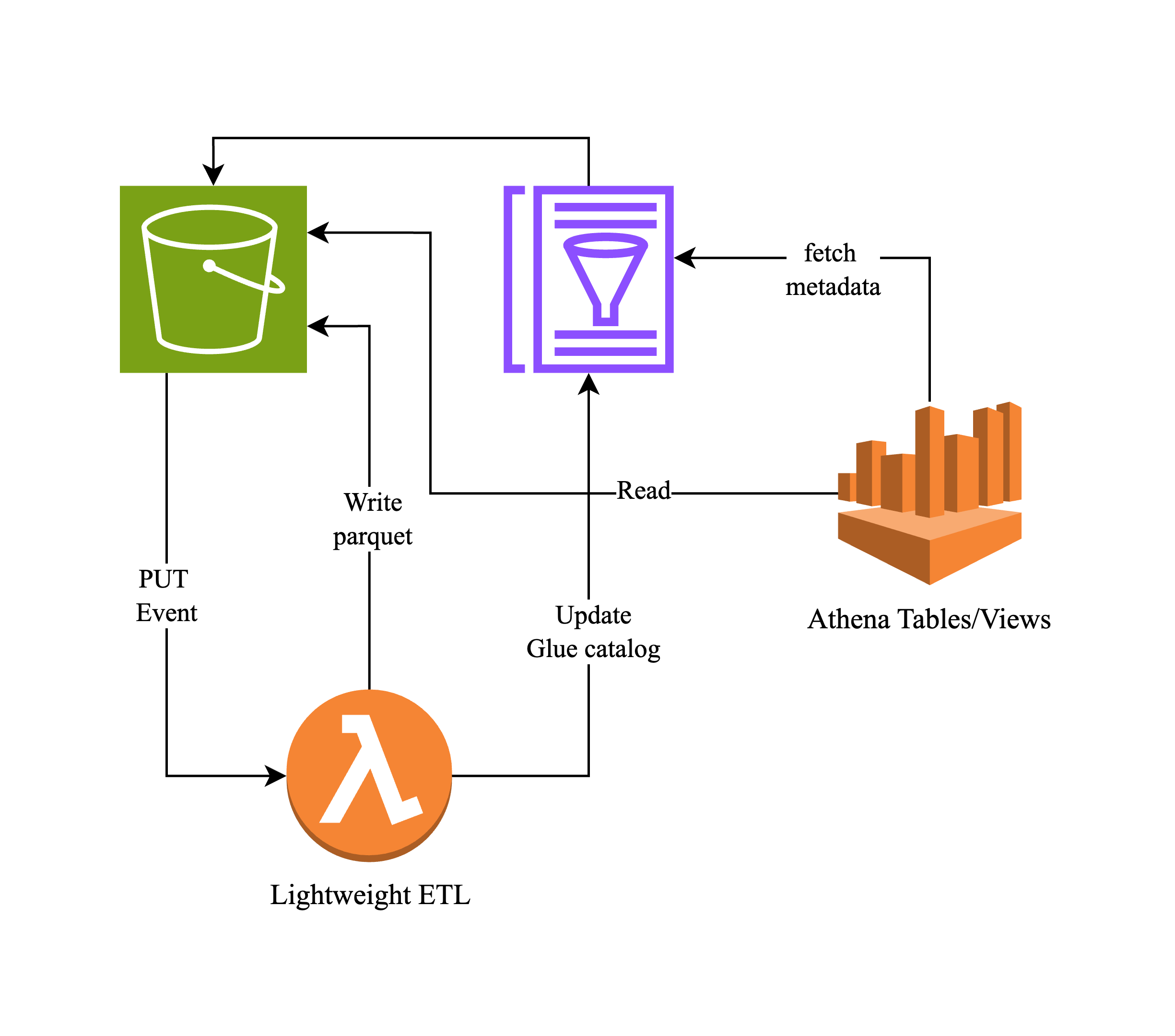
You’re collecting logs from multiple applications and want to run daily reports. Here’s what the pipeline might look like:
Data lands in S3: Logs are pushed into
s3://my-bucket/logs/yyyy/mm/dd/by apps or IoT devices.Lambda gets triggered: An S3
PUTThe event invokes a Lambda function.Transformation happens: Lambda parses the raw data, cleans it, and converts it to Parquet.
Data goes back to S3: Processed data is stored in
s3://my-bucket/processed/….Metadata is managed: Lambda (or Glue) updates the Glue Data Catalog.
SQL does the magic: Athena queries processed data with standard SQL.
Reports are ready: Dashboards in QuickSight or Tableau pull the results.
Why Choose This Stack?
This combo offers a sweet spot between agility and scalability:
| Benefit | Why It Matters |
| No servers to manage | You don’t need to babysit EMR clusters or set up cron jobs |
| Fast and reactive | Lambda responds to events in real-time (or near real-time) |
| SQL-native | Athena lets analysts query raw data without learning new tools |
| Cost-effective | S3 is dirt cheap, Lambda is pay-per-ms, Athena is pay-per-TB scanned |
Best Practices That Unlock Performance
Let’s look at some tactical tips:
Use Parquet + Partitioning
Convert your data to columnar formats like Parquet and partition by date, region, or business logic. This makes Athena 10–100x faster and cheaper.
s3://my-bucket/events/year=2025/month=04/day=10/
Automate Metadata Management
Keep your Glue Catalog up to date by:
Running crawlers on a schedule
Or using
boto3In Lambda, to create/update partitions
Push Transform Logic to SQL
Avoid overloading Lambda with logic-heavy code. Use Athena's SQL power (joins, CTEs, window functions) to do the heavy lifting post-transformation.
Monitor Everything
Set up:
CloudWatch Logs for Lambda invocations
Alarms for error spikes or missing data
SNS notifications to alert teams if something breaks
Should you always use this architecture?
While it may look simple yet powerful data pipeline architecture, it may not be suitable for all your pipeline needs.
| Best For | Not Ideal For |
| Lightweight ETL jobs | Massive multi-TB joins or fact tables |
| Log and event stream processing | Stateful batch workflows |
| Ad-hoc SQL or daily dashboards | Sub-second real-time latency needs |
| Low-cost, low-maintenance stacks | Complex DAGs with retries and dependencies |
Conclusion
In a world obsessed with scale, it reminds us that simplicity still has its place. So the next time you're about to spin up a Spark cluster for a 100 MB log file. MAY BE DON’T!!
About the author
A digital entrepreneur, actively working as a data platform consultant. A seasoned data engineer/architect with an experience of Fintech & Telecom industry and a passion for data monetization and a penchant for navigating the intricate realms of multi-cloud data solutions.
Comments
Join the discussionNo comments yet. Be the first to comment.


